
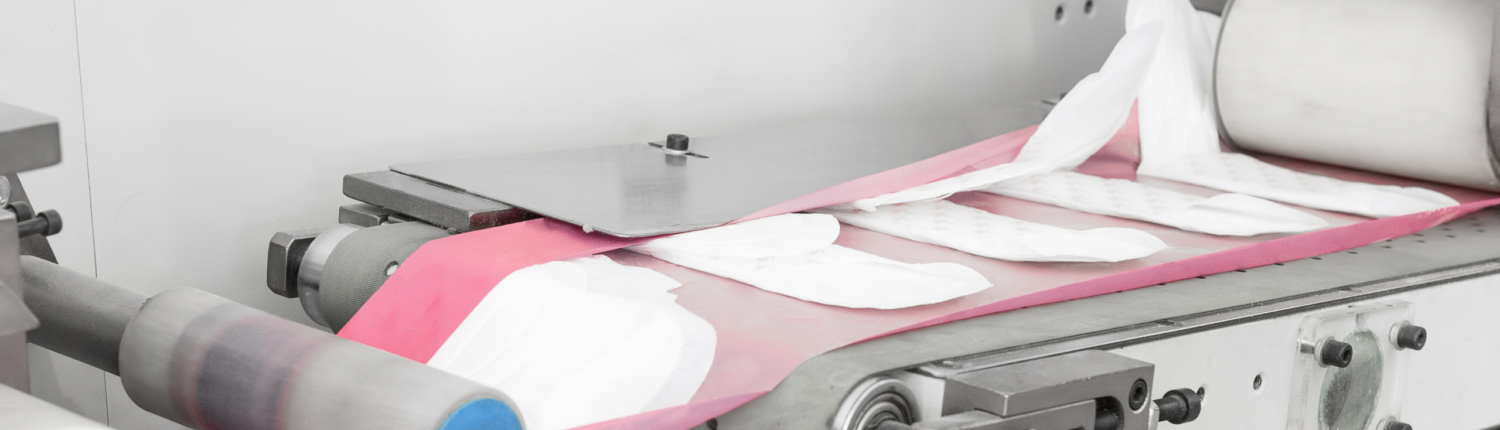
Feminine Care Applications
Feminine care lines often run at high speeds with intricate material handling across multiple web layers, making visibility into minor faults a major challenge.
With LineSpex, teams can monitor key process points like pad forming, folding stations, adhesive application, and final wrapping. Our high-resolution cameras and real-time review tools allow for quick diagnosis of skewed product alignment, transfer losses, or web tension inconsistencies. Whether you’re troubleshooting recurring micro-stoppages or optimizing machine timing, LineSpex provides the insights needed to act fast and maintain performance.
Product Type: Tampons
Process/Equipment Monitored: Punch & Press Forming + Applicator Assembly
Issues Captured Using LineSpex:
- Material folding or tucking errors during compression
- Applicator halves misaligned during ultrasonic sealing
- Inconsistent tamping pressure
Value of High-Speed Footage:
- Captures micro-motion of components and whether they fully seat, align, and engage in <50 ms cycles.
- Can sync to bad product rejection to determine if failures correlate with material lot, operator setup, or tool wear.
Real-World Root Cause Examples:
- Misalignment traced to tooling holder vibration – identified after days of guesswork.
- Applicator defects found to be caused by one missing dowel pin on a rotating plate.
Ideal Deployment: Both. Mobile Cart great for urgent diagnostics on high-reject lines; Permanent install ideal for sites running multiple SKUs with sensitive forming.
Product Type: Sanitary Pads
Process/Equipment Monitored: Die-Cutting and Folding Section
Issues Captured Using LineSpex:
- Pad cut offset or incomplete
- Wing fold inconsistency
- Adhesive placement issues
Value of High-Speed Footage:
- Helps eliminate guesswork during changeovers, especially for smaller SKUs that have tighter tolerances.
- Footage can be reviewed in slow motion by QA, operators, and OEM vendors during troubleshooting calls.
Real-World Root Cause Examples:
- Found that pad die was rotating 0.5 degrees out of axis after cleaning cycle.
- Wing folds collapsed due to adhesive being too hot – captured bubbling and smear patterns.
Ideal Deployment: Permanent for high-volume SKUs; Mobile Cart ideal for seasonal SKU validation and new tooling runs.
Product Type: Pantyliners
Process/Equipment Monitored: Web Laminating + Cut-to-Length Station
Issues Captured Using LineSpex:
- Delamination during high-speed lamination
- Web slip or stretch during ultrasonic bonding
- Edge defects caused by die misfeed
Value of High-Speed Footage:
- High volume lines make it hard to inspect product-by-product in real time. Footage reveals if faults begin at laminate station or die.
- Helps clarify whether adhesive setup, ultrasonic weld timing, or mechanical misfeeds are the source.
Real-World Root Cause Examples:
- An ultrasonic station was applying late and inconsistent pressure, causing partial bonding – confirmed via slow-motion correlation with fault code.
- Liner edge defects matched with intermittent belt slippage that only occurred when ambient humidity rose.
Ideal Deployment: Both – Mobile Cart (during bond validation, environmental tests), Permanent (on chronic reject zones).
Product Type: Individually Wrapped Pads
Process/Equipment Monitored: Primary Wrapper + Reject Ejector
Issues Captured Using LineSpex:
- Wrappers not sealing correctly
- Misfeeds at wrapper infeed causing crumpled product
- Reject mechanism double-ejecting or failing to eject
Value of High-Speed Footage:
- Links fault tags (e.g., print/no print, seal fault) to the exact visual issue.
- Reduces reliance on post-mortem wrapper inspection by letting QA observe defect in formation.
Real-World Root Cause Examples:
- Sealing issue traced back to one heater strip firing 50ms late every 12th cycle – captured via frame-by-frame comparison.
- Found that reject arm was bouncing back too slowly, causing product jam every few cycles.
Ideal Deployment: Permanent if reject rate is high or print inspection system exists; Mobile Cart excellent for spot-diagnosis.
Product Type: Multipacks of Liners or Pads
Process/Equipment Monitored: Multi-Lane Collator + Lane Merge
Issues Captured Using LineSpex:
- Collision or hesitation during product merge
- Lane skipping due to minor variation in timing
- Wrapping too early before stack fully forms
Value of High-Speed Footage:
- Lets ops/engineering review 4–6 lanes side by side in real-time frame-by-frame.
- Troubleshooting is more productive when exact misfire frame is available.
Real-World Root Cause Examples:
- Lane 4 was slightly slower due to dry bearing – created consistent collision every 15th product.
- Merge sensor was triggering too early due to glare from overhead light.
Ideal Deployment: Permanent if multi-lane is prone to variation; Mobile Cart if used for changeover audits.
Product Type: Tampons (bulk packed or individual)
Process/Equipment Monitored: Conveyor Transfer Between Modules
Issues Captured Using LineSpex:
- Product rollover or misfeed between belts
- Transfer misalignment causing jams or backups
- Product skipping gaps during acceleration zones
Value of High-Speed Footage:
- Pinpoints exactly where handoffs fail in <0.3 second windows
- Differentiates between true jam and slip-related failures
Real-World Root Cause Examples:
- One roller had a flat spot from prior damage – caused momentary product deflection every 8 seconds
- Found the servo belt’s PID loop was too aggressive for small product – smoothened after tuning
Ideal Deployment: Mobile Cart (ideal for short-term troubleshooting); Permanent (for lines with frequent reconfigurations).
LineSpex has designed productivity camera and video solutions to view and capture visual evidence of each strategic segment of the automated procedure. Product processing is a critical manufacturing segment; once the processing has been completed there is no going back to the original raw materials. Production stoppages, wastage, process malfunctions and loss of production efficiency effects profitability.