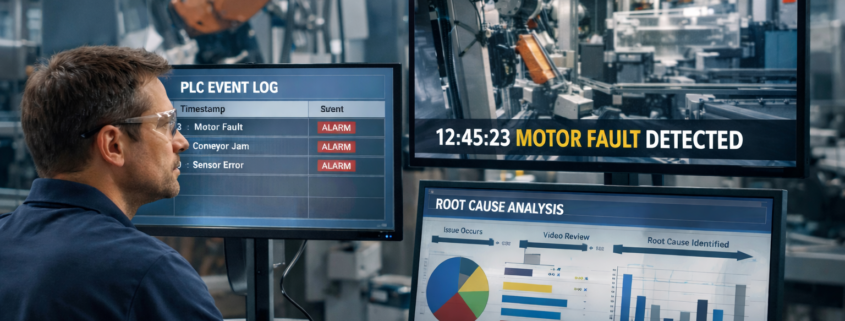
In modern manufacturing environments, production events such as downtime, faults, and cycle interruptions are well captured by PLCs and MES platforms, yet the underlying physical causes of these events often remain unclear.
While MES data accurately records when and where disruptions occur, it typically cannot explain how they unfolded on the line, leaving teams to rely on assumptions, alarms, or operator recollection during investigations. As processes become faster and more complex, this gap between abstract event data and observable machine behavior increases the time and cost of root cause analysis, creating a clear need for a solution that can align trusted production events with synchronized visual evidence.
At a conceptual level, connecting PLC events to video through the MES is not about wiring signals directly from PLCs to cameras.
Instead, it is about letting the MES define, timestamp, and contextualize events, and then linking those events to synchronized video references. MES-centric approach can be particularly effective because the MES acts as the central authority for production events and operational context. Rather than allowing the video system to interpret raw PLC signals directly, the MES consolidates PLC data into structured events such as downtime, faults, rejects, or cycle interruptions. As a result, these events are already enriched with production context, including machine identity, product, work order, and shift information, making them far more meaningful for analysis than individual PLC tags.
Once events are defined and contextualized, they must be made available to the video system in a controlled and reliable manner. Event data is typically transferred from the MES to the video system through structured interfaces such as SQL views, or message-based mechanisms. In many plants, SQL-based integration is the most common approach, where the MES exposes a read-only view containing event identifiers, timestamps, machine or line references, and fault codes. The video system then consumes this data to create logical links between events and recorded footage.
Within this overall architecture, Linespex serves as the visual intelligence layer that bridges MES events and real-world machine behavior without disrupting existing control systems.
By integrating with MES-exposed data sources such as SQL views or APIs, Linespex systems can automatically align high-speed or continuous video streams with production events defined by the MES. In parallel, its DVR and camera platforms are designed to maintain precise time synchronization and to retain high-resolution footage around critical moments, enabling operators and engineers to move seamlessly from an MES event record to the exact visual sequence that explains what physically occurred on the line.
Beyond basic playback, Linespex enhances the system by providing purpose-built tools for manufacturing root cause analysis. Because Linespex does not require direct PLC control or modification of MES logic, it fits cleanly into existing IT and OT architectures while adding a powerful visual dimension to downtime, quality, and process investigations. In this way, Linespex acts as a complementary system that strengthens MES insights rather than replacing or complicating them.
In large, multi-site manufacturing environments, the Linespex solution can be deployed as a standardized reference architecture for linking MES-defined production events to synchronized visual evidence across diverse production lines.Rather than modifying PLC logic or introducing site-specific event handling, Linespex integrates with MES-exposed data sources to consume existing downtime, fault, and production events as they are already defined at the enterprise level. This approach supports consistent event interpretation across facilities while preserving established MES standards, validation processes, and IT/OT governance requirements.
Within this reference architecture, operations and engineering teams use Linespex to navigate from an MES event record to time-aligned video that captures the physical behavior of the line before, during, and after an event. By correlating trusted MES data with visual context, investigations are grounded in observable process behavior rather than inferred conditions. Because Linespex operates as a complementary system and does not require changes to PLC logic or MES workflows, it can be introduced incrementally and scaled across sites without disrupting existing production systems.
In retrospect, connecting PLC events to video through the MES provides a structured and scalable approach to root cause analysis in modern manufacturing environments.
By allowing the MES to remain the authoritative source of production events and using synchronized video as contextual evidence, organizations can bridge the gap between digital records and physical process behavior. This architecture supports more consistent investigations, clearer cross-functional understanding, and more reliable corrective actions, while preserving existing PLC logic and MES workflows.
Learn more about how Linespex can help you create a visual solution via your MES system